
Introduction
Group work can be a very effective tool within your module space. You can assign students to work on specific projects, helping them build up a cohort identify and foster a sense of belonging in their course. This guide outlines how to create groups, and looks at some options that become available to you through groups.
Creating and managing Groups in Blackboard Ultra
To being the process a group set must first be created. A group set is a container that will hold all the groups you intend to create to give relevance to those groups. Once you have created a group set you can then create the required groups within that set. The following post will guide you through this process.
You start the group creation process on the Module Content page. Click the Groups menu item. If you have not created any group sets, you will be prompted to Create a new group set. Click New Group Set in the top right hand corner.
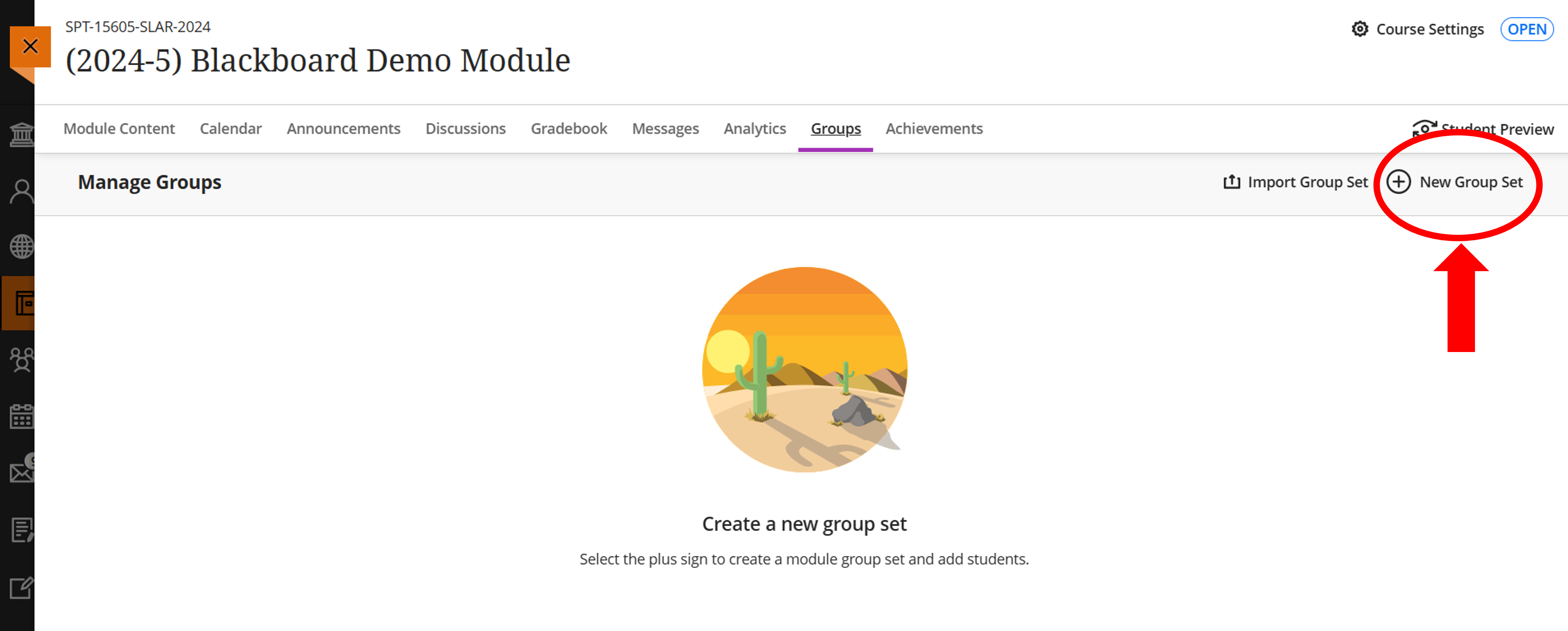
You’ll be presented with the page to create your group set, showing you a list of all Unassigned students.
Give the group set a name, for example ECA Presentation Group. Like most items in Blackboard, the group set you create will be in a hidden state.
Choose how to group students. There are three main ways to enrol students:
- Custom – this option allows the Instructor to allocate students to individual groups
- Randomly Assign – this option will create groups (named New Group 1, New Group 2 and so on) and automatically allocate students randomly to these groups
- Self-enrolment – this option allows students to allocate themselves into a group. In order for this option to be enabled, the Group Set needs to be made visible.
Custom Allocation
There are two main work flows when using the Custom allocation. You can either create the groups first and then add students into these groups, or you can create the individual groups when deciding which group a specific student should be allocated to.
To create groups, click the purple plus icon.
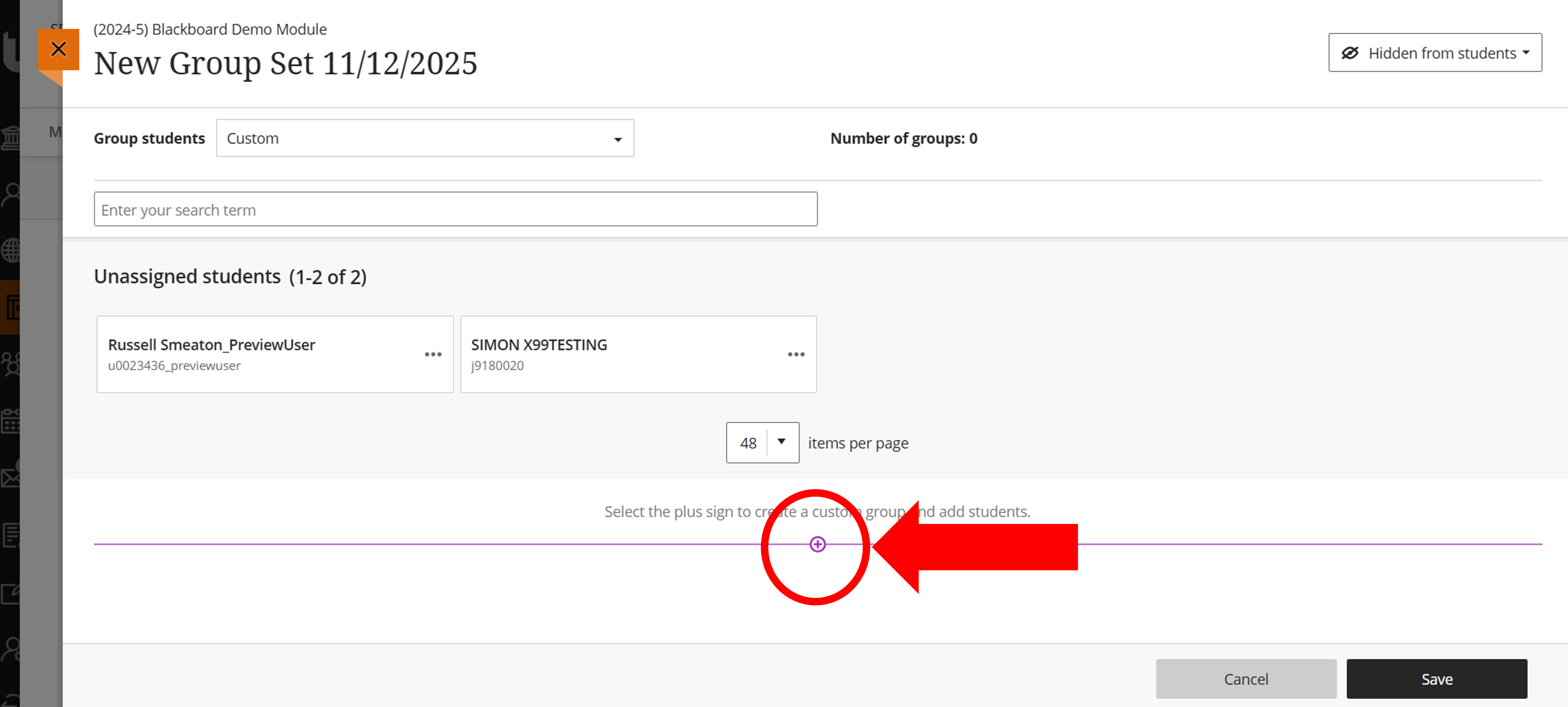
By default, it will be automatically named New Group 1. Click the pen icon next to the name to give it a more meaningful name. You can also give the group a description, to help students understand the purpose of the group.
To create a group when allocating the students, click the relevant student from the Unassigned Student list. You can select multiple students at once.
With the students selected, click the three dots to the right of one of the selected students. From the menu that appears, you can see any groups that have already been created as well as the option to Create a new group. By selecting this option, it will automatically create a new group and add those selected students into that group.
Random Allocation
NB: You need at least four students in order to use the random allocation method so it can allocate two students to two groups.
When you select Random assign, the system will automatically create 3 groups and distribute students randomly to these 3 groups. You can change the amount of groups to create, as well as the number of students per group in the top right hand corner.
Once the allocation has completed, you can still re-arrange students into different groups if required. You can also rename each group as well as give it a description.
When you’re satisfied with the groups, click Save in the bottom right hand corner.
Self-Enrolment
As this option allows students to enrol themselves into pre-created Groups, you need to make the Group Set visible in order for this option to be available. Therefore, create your Group Set as outlined above and then make it Visible to Students in the top right hand corner. You can now choose the Self-Enrolment option from the Group Students drop down menu. The system will automatically generate 3 groups to get you started, which you can configure.
You will now be presented with some Advanced Options to configure the enrolment process.
- You can determine a Enrolment start and end dates if you need to ensure students complete their self enrolment within a time frame. If you select an End Date, you will be prompted whether you want to Auto-Enrol members after this time. By default this is selected.
- You can include a description. This is visible to students before they enrol and so might include a brief outline as to the purpose of the groups.
- You can determine the maximum size of a group. Once a group is full, students can no longer enrol themselves into that group
- Finally, you can choose to hide enrolled members. This option prevents students from seeing who has already enrolled themselves in a group.
Create the groups within the group set. You can create as many groups as you wish. Once you have created the appropriate groups, click Save.
The students can now navigate to the Groups space in the module, and from there they will have the option to Join the groups you have created. Depending on the options, they can potentially move groups. As an Instructor in the module, you also have the ability to move students from one group to another from the Manage Groups page.
Messaging a group
Once you have created your groups, you have some options available to you with regards to communicating with each group. From the Manage Groups page, you can send a message to separate groups. Expand the Group Set by clicking the down arrow to the far right of the Group Set name. This will display all the groups within that set. You will see there’s a Message icon visible. Clicking this will allow you to send a message to all students in that group. NB The Group Set has to be Visible to Students in order for this functionality to work.
You can also do this from the Messages area in your module. Click the New Message icon (over to the right), and you can select the appropriate group via the Recipients drop down list. If you can’t see your intended group, scroll down the list and select the option at the bottom of the list. It’ll vary from module to module, but will be something like “11 more recipients”. The number listed will change, depending on the amount of people/groups in the module. When expanded, you can now select the option to send messages to group sets and/or individual groups.
Alternatively, you might wish to consider using a Discussion Board. By using Release Conditions, you can make a Discussion Board accessible to a specific group, thus creating an interactive space for those group members to discuss content.
Assignments
When you have group sets created, you can make use of the Group Assignment options. This guide will explain the process in more detail: (Guide link to go here)